AMENDMENTS TO MANDATORY INSTRUMENTS
Amendments to SOLAS
The Committee adopted Resolution MSC.496(105) containing amendments to Chapters II-1, III, IV and V, and the appendix (Certificates) of 1974 SOLAS Convention. This resolution contains a complete replacement text of chapter IV of SOLAS, as well as a relocation of provisions for life-saving appliance communication equipment from Chapter III to Chapter IV. The changes in this resolution collectively represent the IMO’s efforts for the Modernization of the Global Maritime Distress and Safety System (GMDSS).
The Committee also adopted Resolution MSC.497(105) containing amendments to the 1988 SOLAS Protocol, concerning the modernization of the GMDSS.
These amendments will enter into force on 1 January 2024. Additional details describing the changes are discussed further in the Navigation, Communications and Search and Rescue section of this Brief.
Amendments to HSC Code
In conjunction with the above noted amendments to SOLAS, the Committee also adopted Resolutions MSC.498(105) and MSC.499(105) containing amendments to Chapters 8 and 14 of the 1994 and 2000 HSC Codes, respectively. These resolutions contain a complete replacement text of chapter 14 of the HSC Code, as well as a relocation of provisions for life-saving appliance communication equipment from Chapter 8 to Chapter 14. These amendments relate to Life-saving appliances and arrangements and Radiocommunications, as well as the Record of Equipment for High-Speed Craft Safety Certificate, concerning the modernization of the GMDSS.
These amendments will enter into force on 1 January 2024. Additional details describing the changes regarding GMDSS are discussed further in the Navigation, Communications and Search and Rescue section of this Brief.
Amendments to IMSBC Code
The Committee adopted Resolution MSC.500(105) containing several amendments to the International Maritime Solid Bulk Cargoes (IMSBC) Code. This set of amendments (06-21 Amendments) includes the following:
- Reclassification of ammonium nitrate based fertilizer (non-hazardous);
- Amendments to section 7 addressing “Cargoes which may liquefy or undergo dynamic separation;
- Addition of new definitions relating to the phenomenon of "dynamic separation," including deliberations regarding the definition of "group A" cargoes;
- Addition of new schedules for lead concentrate and leach residue containing lead;
- Substance identification number for bulk cargoes.
These amendments will enter into force on 1 December 2023, but may be applied by Administrations on a voluntary basis beginning 1 January 2023.
Amendments to IMDG Code
The Committee adopted Resolution MSC.501(105) containing several amendments to the International Maritime Dangerous Goods (IMDG) Code. This set of amendments (41-22 Amendments) is intended to alight with the amendments to the UN Recommendations on the Transport of Dangerous Goods, 21st Revised Edition. In addition to the regular review of new and existing substances, these amendments include the following:
- new definition for "pressure receptacle shell" in 1.2.1 of the IMDG Code;
- guidance on marking of refillable UN pressure receptacles; and
- guidance on portable tanks with shells made of fiber-reinforced plastic (FRP) materials.
These amendments will enter into force on 1 January 2024, but may be applied by Administrations on a voluntary basis beginning 1 January 2023.
Draft Amendments to IGC Code and IGF Code
The Committee approved draft amendments to the Table 6.3 of the IGC Code and Table 7.3 of the IGF Code to confirm the acceptability of high manganese austenitic steel under these Codes, and to provide testing requirements for its use in cryogenic service. These amendments are subject to adoption at MSC 106 (Nov-2022).
In conjunction with these amendments to the IGC Code and IGF Code, the Committee also approved the following supporting circulars:
- MSC.1/Circ.1648, Amendments to the Guidelines for the acceptance of alternative metallic materials for cryogenic service in ships carrying liquefied gases in bulk and ships using gases or other low-flashpoint fuels (MSC.1/Circ.1622); and
- MSC.1/Circ.1599/Rev.2, Revised guidelines on the application of high manganese austenitic steel for cryogenic service (MSC.1/Circ.1599/Rev.1).
CARRIAGE OF INDUSTRIAL PERSONNEL
New SOLAS Chapter XV – Safety Measures for Ships Carrying Industrial Personnel
The Committee approved a draft new SOLAS Chapter XV addressing cargo ships and high-speed cargo craft of 500 gross tonnage and upward, carrying more than 12 industrial personnel. For the purposes of this new chapter, industrial personnel are persons transported or accommodated on board for the purpose of performing offshore industrial activities (construction, maintenance, decommissioning, operation or servicing of offshore facilities related, but not limited, to exploration and exploitation of resources by the renewable or hydrocarbon energy sectors, aquaculture, ocean mining or similar activities) performed on board other ships and/or offshore facilities. Wherever the number of industrial personnel onboard appears as a parameter for application of a regulation, it shall be taken to mean the aggregate number of industrial personnel, special personnel and passengers carried onboard (where the number of passengers shall not exceed 12 persons).
This amendment to SOLAS will coincide with the adoption of the Code of Safety for Ships Carrying Industrial Personnel, or IP Code. The new SOLAS Chapter XV will be structured to clarify the application of the mandatory provisions in the IP Code to vessels normally certified under SOLAS and the HSC Code.
For existing ships constructed before entry into force of SOLAS Chapter XV that comply with the Interim Recommendations on the Safe Carriage of More Than 12 Industrial Personnel on Vessels Engaged on International Voyages (MSC.418(97), adopted 25 November 2016), a grace period will be given before selected regulations in the IP Code must be complied with:
• Existing cargo ships which carry more than 12 industrial personnel must comply with selected requirements of the IP Code by the first intermediate or renewal survey after entry into force of these amendments.
• Existing high-speed cargo craft which carry more than 12 industrial personnel must comply with selected requirements of the IP Code by the third periodical or first renewal survey after entry into force of these amendments.
Existing cargo ships or high-speed cargo craft, irrespective of date of construction, which have not been authorized to carry more than 12 industrial personnel prior to entry into force of SOLAS Chapter XV must fully comply with and be certified in accordance with the IP Code before carrying more than 12 industrial personnel.
These amendments are subject to adoption at MSC 106 (Nov-2022), for entry into force on 1 July 2024.
Code of Safety for Ships Carrying Industrial Personnel (IP Code)
In association with the previous section, the Committee also approved the draft Code of Safety for Ships Carrying Industrial Personnel, or IP Code. In support of expanding maritime offshore and energy sectors, the IP Code is intended to supplement existing IMO instruments in order to provide international safety standards for the carriage of industrial personnel onboard cargo ships and high-speed cargo craft.
Using SOLAS and the 2000 HSC Code as a basis for regulatory compliance, the IP Code provides goals, functional requirements, and additional regulations aimed to facilitate the safe carriage and transfer of industrial personnel by addressing additional risks connected to such operations. The supplemental regulations of the IP Code address the following subjects:
- Safe transfer of personnel
- Subdivision and stability
- Machinery installations
- Electrical installations
- Periodically unattended machinery spaces
- Fire safety
- Life-saving appliances
- Dangerous goods
Additionally, Administrations and Recognized Organization will document compliance with the IP Code through the issuance of an Industrial Personnel Safety Certificate. This code is subject to adoption at MSC 106 (Nov-2022), for entry into force on 1 July 2024.
Furthermore, the Committee agreed to a second phase of work on the IP Code to address outstanding matters:
- clarifying the interaction between the IP and SPS Codes,
- incorporating provisions for passenger ships and,
- provisions for sleeping berths for high-speed craft carrying industrial personnel or carrying more than 60 persons.
MEASURES TO IMPROVE DOMESTIC FERRY SAFETY
Model Regulations on Domestic Ferry Safety
The Committee adopted Resolution MSC.518(105) containing a finalized text of the Model Regulations on Domestic Ferry Safety. The resolution contains regulations for both new build and conversion ferries, as well as manning and additional safety management requirements. The Model Regulations have been informed by several expert group meetings, and have been developed in support of Member States concerned with improving the safety of ferry services within their area of authority. They provide a general framework of provisions on domestic ferry safety for Governments to be guided by in developing specific national law or to serve as a basis for intergovernmental agreements as deemed appropriate by each Member State.
The IMO Secretariat will also commence development of explanatory notes to support the Model Regulations, for consideration at MSC 107. Future work is also intended to develop associated online training material to facilitate the implementation of these measures to improve domestic ferry safety.
SAFETY OF SHIPS RELATED TO THE USE OF FUEL OIL
Draft Amendments on Fuel Oil Safety Related to Flashpoint Requirements
The Committee approved draft amendments to SOLAS Chapter II-2/Regulation 4 which are intended to enhance the safety of ships related to use of fuel oil by addressing concerns regarding the verification of the flashpoint of bunkered fuel oil. These draft amendments address this issue in three parts:
1) The approved draft amendments will require documentation of the flashpoint of the actual fuel batch when bunkering. Under this proposed regulation, ships shall be provided with a declaration signed and certified by the fuel oil supplier's representative that the oil fuel supplied is in conformity with regulation SOLAS II-2/4.2.1 and the test method used for determining the flashpoint. The bunker delivery note that is to be provided prior to bunkering must contain the flashpoint specified in accordance with standards acceptable to the Organization, or a statement that flashpoint has been measured at or above 70ºC;
2) The draft amendments will also require Member States to report to the IMO any confirmed cases where oil fuel suppliers have failed to meet the flashpoint requirements of the Organization; and
3) The draft amendments will require Member States to take appropriate actions against oil fuel suppliers that have been found to deliver oil fuel that does not comply with flashpoint requirements of SOLAS regulation II-2/4.2.1.
These amendments will be subject to adoption at MSC 106 (Nov-2022). An intersessional correspondence group will progress work on guidelines for fuel oil sampling procedures related to these amendments.
MARINE AUTONOMOUS SURFACE SHIPS (MASS)
Road Map for Maritime Autonomous Surface Ships
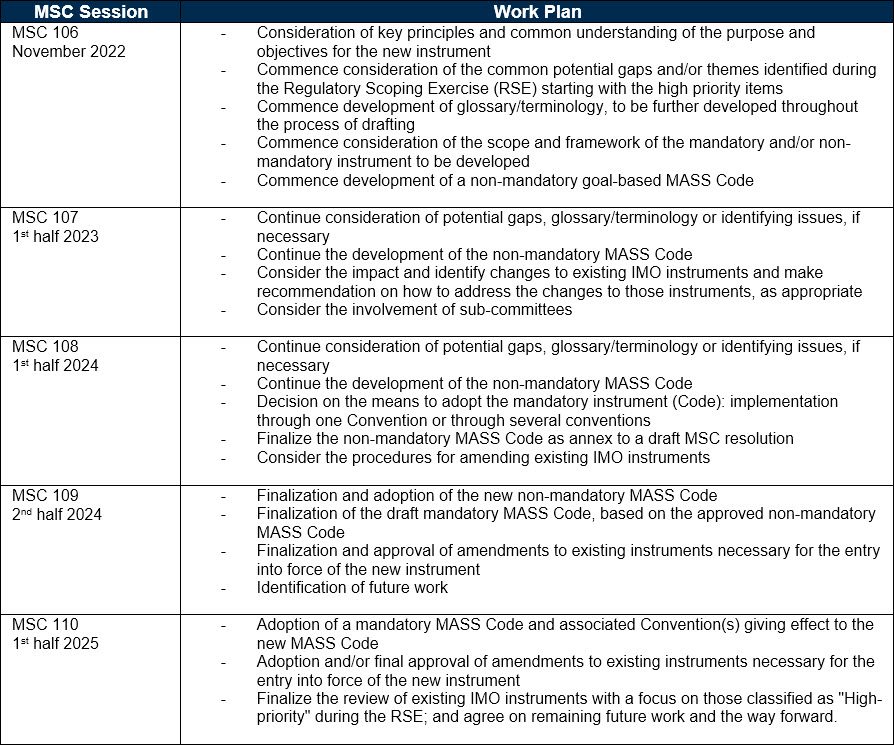
The Committee received proposals from several Member States for development of guidance for MASS in the IMO regulatory framework and agreed to the development of a roadmap and instructed the working group to finalize it. The Working Group on MASS was established and was provided with the draft roadmap to address MASS operations in the IMO regulatory framework. The objective of the working group was to develop a non-mandatory instrument in the form of a goal-based MASS Code, a first step towards a mandatory instrument in the future. This would initially be applicable to cargo ships only while in development, and to eventually be applicable to passenger vessels once finalized and made mandatory.
The roadmap for a goal-based MASS Code has been developed to be further implemented through the work plan in the following MSC sessions.
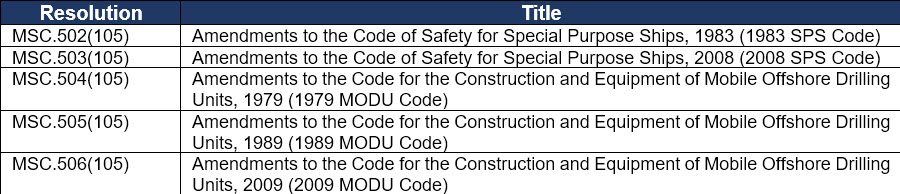
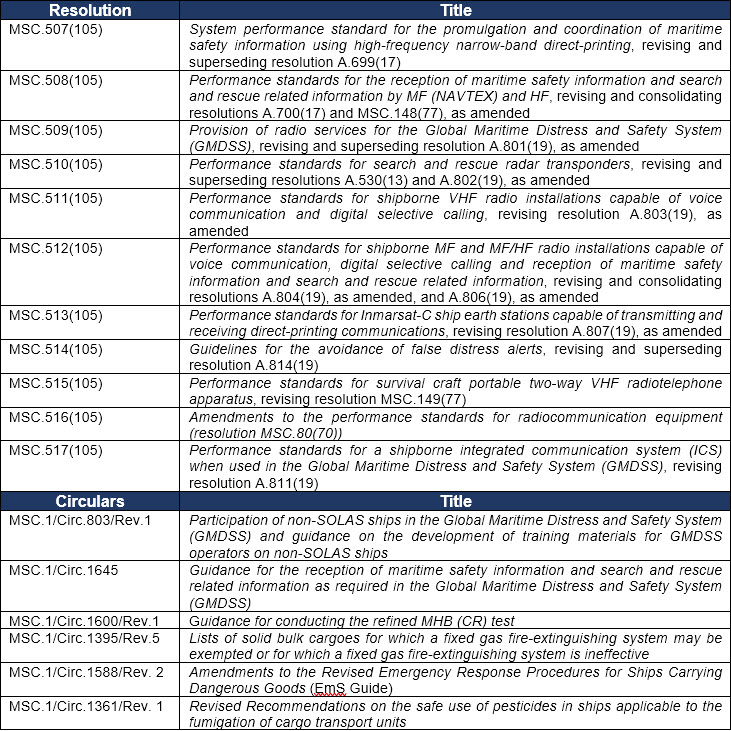
The above listed Resolutions will enter into force on 1 January 2024.
The Committee discussed options to address cost implications for maritime safety information (MSI) and search and rescue (SAR) information providers concerning the dissemination of information over multiple recognized mobile satellite service providers. In a previous session, concerns were raised that increases in commercial competition would eventually lead to recognition of new mobile satellite service providers, and this would come with consequential costs for the MSI providers as they seek to transmit information across multiple communications networks. While some Member States asserted that technological advances over time would allow for interoperability among service providers, while others supported the establishment of a fund to provide monetary support to Member States facing financial difficulties in carrying out the dissemination of MSI.
After deliberations, the Committee could not conclude on any particular option to address cost implications for MSI and SAR information providers concerning the dissemination of information over multiple recognized mobile satellite services. The NCSR Sub-Committee will be tasked to develop technical solutions for the dissemination of MSI and SAR related information over multiple recognized mobile satellite services, including interoperability and interconnectivity issues.
Unified Interpretations to Provisions of IMO Safety, Security, and Environment-related Conventions
The Committee approved circular MSC.1/Circ.1535/Rev.2 containing a unified interpretation of regulation 37(3) of the 1988 Load Lines Protocol, which currently does not provide clarity on the superstructure reduction for freeboard calculations for type ‘B’ ships or ships with reduced type-B freeboard. This unified interpretation clarifies that:
1) for ships assigned a type 'B' freeboard, including reduced type 'B', if the effective length of a forecastle is less than 0.07L, a superstructure deduction cannot be applied to the ship; and
2) in case the ship has a full superstructure (one that extends from AP to FP, per regulation 3(10)(h) of Annex B of the 1988 Load Lines Protocol), the deduction for a superstructure may be applied in accordance with regulation 37(1) of Annex B of the 1988 Load Lines Protocol.
The Committee approved circular MSC.1/Circ.1362/Rev.1 containing a unified interpretation of SOLAS regulations II-1/5.4 and II-1/5.5, clarifying that in cases where the lightship properties of a ship changed beyond the specified deviation limits, the instruments/documents (such as loading manual, loading computer and stability computer) utilizing the lightship properties should be amended based on the new lightship properties, and the lightweight calculation should also be verified on board.
The Committee approved circular MSC.1/Circ.1653 to update the Unified Interpretation Regarding Timber Deck Cargo in the Context of Damage Stability Requirements (MSC/Circ.998), based on an update to IACS Unified Interpretation SC161 which was previously annexed to MSC/Circ.998. The update to UI SC161 was necessary due to relevant SOLAS amendments and the revocation of the 1991 Timber Code, which was replaced by the Code of Safe Practice for Ships Carrying Timber Deck Cargoes, 2011 (Resolution A.1048(27)) (2011 TDC Code).
The Committee approved circular MSC.1/Circ.1654 containing a unified interpretation of paragraph 4.2.1 of the Code on Noise Levels On Board Ships (resolution MSC.337(91)) to clarify the application of noise limits for “workshops other than those forming part of machinery spaces”. Such spaces are to be understood to be spaces which are separated from the engine-room with bulkheads extending from deck to deck, which may include access doors of the equivalent acoustic insulating properties as the bulkhead. Workbenches and workstations located inside the machinery space should not be considered as "workshops other than those forming part of machinery spaces". Noise level limits should be assigned accordingly for these two types of workshops.
The Committee approved circular MSC.1/Circ.1651 containing amendments to MSC.1/Circ.1625 (as amended), which provides unified interpretations of the IGC Code. This amendment contains a unified interpretation of the term "duct" in paragraphs 5.4.4 and 5.13.2.4 of the IGC Code. The interpretation being amended relates to the outer duct in gas fuel piping systems, and new paragraph has been added to the interpretation to make a distinction between the terms “duct” and “structural pipe duct”. Criteria for design of gas valve unit rooms has also been added to the interpretation.
Other Developments
The Committee adopted Resolution MSC.495(105) illustrating the Committee’s grave concern on the impact of the Russian Federation aggression against Ukraine. The resolution encourages the IMO Secretary-General to continue efforts to assist in the safe and expeditious evacuation of seafarers stranded in Ukrainian ports as well as to call for immediate and unconditional cease of aggressions against Ukraine. The resolution also urges Member States to raise concerns regarding the collateral impact on seafarers, port workers, safety and security of navigation, global supply chains and food security in order to alleviate these critical concerns and aim to contribute to a peaceful solution.
Explanatory Notes to the Interim Guidelines on Second Generation Intact Stability Criteria
To support the uniform interpretation and application of the Interim Guidelines on Second Generation Intact Stability Criteria (MSC.1/Circ.1627) which was adopted at MSC 102, the Committee has approved circular MSC.1/Circ.1652 with an accompanying Explanatory Note to assist the shipping industry in understanding and applying certain concepts within the Interim Guidelines. In six appendices, the Explanatory Notes provide guidance on the following aspects:
Appendix 1 – Physical description of the stability failure modes addressed by the second generation intact stability criteria
Appendix 2 – Examples of assessments using vulnerability criteria according to the second generation intact stability criteria
Appendix 3 – Elements for numerical modelling of roll motion in the vulnerability criteria of the second generation intact stability criteria
Appendix 4 – Theoretical background, validation and application examples for the Guidelines on direct stability assessment
Appendix 5 – Theoretical background, validation, and application examples for the Guidelines on operational measures
Appendix 6 – Application examples of treatment of loading conditions
Draft Amendments to the 2011 ESP Code
Based on the findings of a recent marine safety investigation, the Committee approved draft amendments to the 2011 ESP Code that are intended to align the requirements for inspections of void spaces bounding cargo holds with the existing requirements for inspections of water ballast tanks. For ships that have undergone a major conversion into a bulk carrier or ships that were originally designed to be a bulk carrier and have been subjected to a major conversion, additional amendments would require such tanks and other spaces to be subject to annual examinations if the tank structure has been subjected to major conversion and where a hard protective coating is found to be in “less than GOOD” condition. The proposed amendments will apply to bulk carriers of single-side skin construction and double-side skin construction.
Several additional clarifying amendments to the 2011 ESP Code were also finalized:
1) Clarification that the ESP Code is not applicable to oil tankers carrying oil in independent tanks not part of ship's hull; and
2) Clarification of requirement for examination of ballast tanks at annual surveys.
These amendments are subject to adoption at MSC 106, for entry into force on 1 July 2024.
The Committee adopted resolution MSC.188(79)/Rev.1 containing amendments to the Performance Standards for Water Level Detectors on Bulk Carriers and Single Hold Cargo Ships Other Than Bulk Carriers (MSC.188(79)), which are intended to broaden the application of this standard to all vessels subject to Regulations 25 and 25-1 of SOLAS Chapter II-1, and Regulation 12 of SOLAS Chapter XII. In addition, the standard was amended to incorporate new requirements on:
1) operation in low temperatures;
2) instances when bilge level alarms are used as water level detectors on multiple hold cargo ships for compliance with new SOLAS regulation II-1/25-1;
3) clarification on where the height of the water level detector is measured when a lining or insulation is fitted to a hold.
Additionally, the Committee agreed that the revised Performance Standards should apply to water level detectors installed on or after 1 January 2024.
The Committee approved circular MSC.1/Circ.1647 providing interim guidelines for the safety of ships using fuel cell power installations. These Interim Guidelines have been developed to provide international standard provisions for ships using fuel cell power installations. The goal of these Interim Guidelines is to provide criteria for the arrangement and installation of fuel cell power installations with at least the same level of safety and reliability as new and comparable conventional oil-fueled main and auxiliary machinery installations, regardless of the specific fuel cell type and fuel. These Interim Guidelines are intended to apply to ships which must comply with SOLAS Chapter II-1 Part G (Ships Using Low-Flashpoint Fuels).
Postponement of Agenda Items
Due to closure of the IMO Building and limitations of the virtual meeting format utilized at this session, the Committee agreed to postpone consideration of the following proposals. Related submissions will be referred to MSC 106.
1. Measures to Enhance Maritime Security (Agenda Item 8)
2. Piracy and Armed Robbery Against Ships (Agenda Item 9)
3. Unsafe Mixed Migration By Sea (Agenda Item 10)
4. Formal Safety Assessment (Agenda Item 11)
5. Proposals for the following new outputs (Agenda Item 18) :
a. Amendment of the regulation relating to the system control requirements of fixed gas fire-extinguishing systems in the FSS Code;
b. Amendments to SOLAS regulation II-2/10.8.1 to provide unified requirements for deck foam systems on tankers;
c. Amendment of SOLAS regulation V/23 and associated instruments to improve the safety of pilot transfer arrangements;
d. Development of guidance to assist competent authorities in the implementation of the Cape Town Agreement of 2012;
e. Amendments to Chapter V of the SOLAS Convention;
f. Development of measures to ensure safe operation of elevators on board ships.



.png)
.png)
.png)