UK Monitoring, Reporting, Verification (MRV)

true false

ABS keeps you up to date with the most recent and upcoming United Kingdom regulations. Contact us today and let us help you prepare your fleet for compliance.

Overview

The EU Regulation on Monitoring, Reporting and Verification (MRV) of Carbon Dioxide (CO2) Emissions from Maritime Transport (EU MRV)—excluding the amendments introduced in 2023—has been transposed into UK law through UK Statutory Instrument 2018 No. 1388 (SI 2018/1388), referred to as the UK MRV Regulations 2018.

 To support implementation of the UK MRV regime, the following documents have been issued:

  • Marine Information Note 669 (MIN 669): Guidance on reporting emissions data under the UK MRV Regime.
  • Marine Guidance Note 662 (MGN 662): Templates for the UK MRV regime.

As of 1 January 2022, the UK MRV regime applies to all ships of 5,000 GT and over transporting cargo and/or passengers for commercial purposes to and from UK ports, between UK ports or within UK ports (including while at berth). Exemptions to the types of vessels within scope of UK MRV mirror those under the EU MRV regime (e.g., for warships).

Voyages and port stays subject to the UK MRV regime include:

  • Voyages between two UK ports
  • Voyages between a UK and non-EEA port (including to/from UK overseas territories or Crown dependencies)
  • UK port stays related to the above voyages and when at berth at a UK port on voyages between UK and EEA ports

To avoid duplication, voyages between UK and EEA are excluded from the UK MRV regime. Data for these voyages must continue to be submitted to the European Commission under the EU MRV regime.

The methods for monitoring and reporting annual data required under UK MRV must be documented in the Monitoring Plan (MP), assessed by a verifier accredited by the United Kingdom Accreditation Service (UKAS). An existing EU MRV MP may be modified to cover the UK MRV requirements.

Monitoring and Reporting Requirements

The following data must be monitored per voyage, as specified in the assessed MP:

  • Port of departure and port of arrival, including the date and hour of departure and arrival.
  • Amount and emission factor for each type of fuel consumed in total.
  • CO2 emitted.
  • Distance travelled.
  • Time spent at sea.
  • Cargo carried.
  • Transport work.

The following parameters must be monitored and included in the UK MRV Emissions Report on an annual basis:

  • The amount and emission factor for each type of fuel consumed in total.
  • Total aggregated CO2 emitted within the scope of the Regulation.
  • Aggregated CO2 emissions from all voyages between ports in the UK.
  • Aggregated CO2 emissions from voyages which departed from ports in the UK (except those going to a port in the EEA).
  • Aggregated CO2 emissions from voyages to ports in the UK (except those originating from a port in the EEA).
  • CO2 emissions which occurred within ports in the UK at berth (including when stopping on voyages between UK and EEA ports).
  • Total distance travelled.
  • Total time spent at sea.
  • Total transport work.
  • Average energy efficiency.

The UK no longer has access to the THETIS-MRV database and is developing its own digital system to receive MRV data which is expected to be in place in 2026. Until the digital solution is operational:

  • Ship operators are not required to report emissions for voyages between UK ports, between UK and non-EEA ports, or from vessels at berth in a UK port.
  • Ship operators are not required to obtain a Document of Compliance (DoC) for these emissions.

However, the legal obligation to monitor vessel emissions remains in place. Once UK’s reporting system is ready, data from intervening years must be submitted

Treatment of Biofuels

In line with Directive (EU) 2018/2001, Annex V, Part C, Item 13, biofuels and bioliquids certified as sustainable under schemes recognized by the European Commission in accordance with the Renewable Energy Directive shall be assigned a CO2 emission factor of zero under the UK MRV regime.

Unlike the EU MRV, which requires reporting each component of a biofuel blend separately, the UK MRV stipulates that the CO2 emission factor for the blend be calculated as a mass-weighted average of the emission factors of its components.

Example:

For a B30 heavy fuel oil (HFO) blend (30% fatty acid methyl ester (FAME) and 70% HFO), the CO2 emission factor is calculated as:

0.3 × 0 + 0.7 × 3.114 = 2.180 [(g CO2)⁄g fuel]

Compliance Timeline

From 1 January 2022 onwards:

  • Collect data required under UK MRV regime following the procedures established in the Monitoring Plan. To reduce complexity and save significant time for operators, the ABS Emissions Reporter system can verify submitted data and create three different verified reports for IMO DCS, UK MRV and EU MRV as applicable.

By 30 April each year:

  • Submit an emissions report for the preceding reporting period to the verifier for verification.

Once the reporting obligation commences:

  • By 30 April each year: Submit the verified emissions report for the preceding year to the UK Administration.
  • By 30 June each year: Ensure the UK Document of Compliance (DoC) is available onboard, confirming submission of a validated emissions report under UK MRV for the previous reporting period. This is in addition to the EU MRV DoC.

Compliance and Enforcement

Until reporting commences and further guidance is issued:

  • Ship operators are not required to carry a valid DoC for ships that were subject to the UK MRV regime in the previous reporting period.
  • No enforcement action will be taken by the UK Marine and Coastguard Agency (MCA).
  • An EU DoC will be recognized for voyages between UK and EEA ports.

Once reporting commences, a separate UK DoC will be required for voyages under UK MRV from 2022 onwards.

ABS as UK MRV Verifier

ABS is accredited by UKAS as a UK MRV verifier.

UK ETS Maritime Expansion

The UK Emissions Trading Scheme (UK ETS) replaced the UK’s participation in the European Union Emissions Trading Scheme (EU ETS) on 1 January 2021. The scope of the UK ETS will expand to domestic maritime from July 2026, introducing a cap-and-trade system, similar to the EU ETS framework.

While the UK’s Monitoring, Reporting and Verification (MRV) regime will serve the basis for the monitoring and reporting requirements for the UK ETS, several deviations are expected, such as the definition of the eligible voyages, the inclusion of methane and nitrous oxide emissions and the requirement to submit the monitoring plans to the regulator, rather than to a verifier.

Application of UK ETS for shipping

The UK ETS expansion to maritime will apply to ships of 5,000 GT and above and will cover carbon dioxide (CO2), methane (CH4) and nitrous oxide (N2O) emissions in alignment with the EU ETS regime. The greenhouse gas emissions will be calculated on a carbon dioxide equivalent (CO2e) basis, based on their Global Warming Potential (GWP):

  • CO2: GWP of 1 per tonne
  • CH4: GWP of 28 per tonne
  • N2O: GWP of 265 per tonne

The emissions in scope are the following:

  • Emissions from domestic voyages, defined as those between UK ports, including those which start and end at the same port. The definition includes emissions while at anchor and while moored.
  • Emissions within UK ports, comprising emissions at berth in UK ports and emissions from movements within UK ports, regardless of whether the voyage is domestic or international.


The UK ETS MRV reporting requirements will also apply to ships and ship movements not serving the purpose of transporting cargo or passengers, which are currently not in scope of the UK MRV regime.

The scheme will use a Tank-to-Wake emissions accounting approach with standard emission factors for conventional fuels. Sustainable fuels of biological and non-biological origin will be zero-rated.

Coverage and Exemptions

UK ETS will cover 100% of emissions from domestic voyages and port activities. The UK ETS Authority intends to expand the scheme from 2028 to include emissions from international maritime voyages starting or ending in the UK. These voyages will be subject to the UK ETS carbon price for 50% of their emissions, in line with the current EU ETS scope.

A 50% deduction from UK ETS surrender obligation will be granted for voyages between Northern Ireland and Great Britain, to avoid disparities until international voyages are included.


The following exemptions are provided, subject to review in 2028:

  • Ferry services to Scotland’s islands and certain peninsular communities.
  • Fish catching and fish processing ships.


Implementation Timeline

The UK ETS maritime regime will launch on 1 July 2026, so all compliance obligations will apply from this date.

  • First scheme year: 1 July – 31 December 2026
  • Subsequent scheme years: Calendar year (1 January – 31 December)

The deadline for submitting the verified Annual Emissions Reports is 31 March after the scheme year ends, and the deadline for surrendering allowances is 30 April.

To ease transition, the Authority will allow a “double-surrender” provision for the 2026 and 2027 scheme years. This means that the surrender deadline for allowances related to the first scheme year will also be 30 April 2028. Operators will still be able to purchase allowances at any point once they have opened an account in the UK Emissions Trading Registry.

Figure 1: Compliance obligations for the 2026 scheme year.

Figure 2: Compliance obligations for the 2027 scheme year.

Expansion to Offshore Ships

The inclusion of offshore ships within the UK ETS will be delayed until 1 January 2027, aligning with the EU ETS timeline to avoid market distortion. Treatment will broadly follow EU ETS, reducing administrative complexity. Further guidance will be issued in the future to clarify:

  • Ship types covered under “offshore ships”
  • Details on offshore facilities


Compliance Responsibility

The Registered Owner of a ship will be the default responsible entity unless the ISM Company assumes responsibility through a legally binding agreement with the Registered Owner. In this case, evidence of the agreement in place between those two entities will be required, to the satisfaction of the regulator.

Each operator will be required to submit one Emissions Monitoring Plan (EMP) and one Annual Emissions Report (AER), rather than separate documents for each ship.

  • The EMP must be submitted for approval to the regulator—rather than to an accredited verifier—listing the ships under the operator’s responsibility.
  • Operators must appoint an independent verifier accredited by the UK Accreditation Service (UKAS) to verify their AER, which will include the emissions from each ship and aggregated data.
  • The issuance of a Document of Compliance (DoC) will not be required under the UK ETS.

The regulator will be assigned based on the location of the operator’s place of residence or registered address. In case operators do not have a registered office or place of residence in the UK, regulatory responsibility will fall to the Environment Agency. The designated regulators are as follows:

  • England – Environment Agency
  • Northern Ireland – Northern Ireland Environment Agency
  • Scotland – Scottish Environment Protection Agency
  • Wales – Natural Resources Wales.

Allowances and Penalties

The UK ETS maritime regime will follow the principles of the EU ETS, allowing operators to purchase allowances via government auctions or on the secondary market throughout the year in preparation for surrender. To purchase allowances, operators must hold an account in the UK Emissions Trading Registry.

The UK ETS expansion to maritime will mirror existing provisions for installation operators and aircraft operators covered by the scheme, including the application of civil penalties for non-compliance.

Actions for Compliance

  1. Develop an Emissions Monitoring Plan (EMP) in accordance with the UK ETS requirements and submit it for approval to the appropriate regulator before the scheme begins on 1 July 2026.
  2. From 1 July 2026, and from 1 January in subsequent years, start monitoring CO2, CH4 and N2O emissions according to the approved EMP.
  3. By 31 March following the end of each scheme year, submit the verified Annual Emissions Report (AER) detailing the emissions for each ship under your responsibility.
  4. By 30 April each year, surrender the required number of allowances to cover your verified emissions.
    1. For the first two scheme years, 2026 and 2027, the surrender deadline is 30 April 2028 under the double-surrender provision.

Frequently Asked Questions


1.     Why has the UK introduced its own MRV regime?

After Brexit, on January 31, 2020, the United Kingdom (U.K.) transposed the EU legislation into UK law through Statutory Instrument 2018/1388, establishing the UK MRV regime. This regime mirrors the EU MRV framework and aims to monitor, report, and verify emissions data from ships calling at UK ports.


2.     How are biofuels treated and reported under UK MRV?

Biofuels and bioliquids, which are certified as sustainable under schemes recognized by the European Commission in accordance with the Renewable Energy Directive II (Directive (EU) 2018/2001), may be assigned a CO2 emission factor of zero. For blends, the CO2 emission factor should be based on the mass-weighted average of the emission factors for the respective fuels.


3.     Should voyages between a UK port and an EU port be reported under both regimes?

To avoid duplication, voyages between UK and EEA ports (and vice versa) are not to be recorded under the UK MRV regime. Data on these voyages should continue to be submitted to the European Commission under the EU MRV regime.

Only the emissions generated during UK port stays related to these voyages are to be reported in the UK MRV Emissions Report.


4.     Should voyages to/ from ports in UK Overseas Territories and Crown Dependencies be reported under the UK MRV?

Ports in the UK Overseas Territories and Crown Dependencies are not considered UK ports under the UK MRV regime. Accordingly, voyages between two Crown Dependencies or Overseas Territories or from a port in an Overseas Territory or Crown dependency to a non-UK port should not be included.

However, voyages between a port in the UK and a port in one of the UK Overseas Territories or Crown Dependencies shall be reported under the UK MRV regime.


5.     Should voyages to/from Port of Akrotiri (CYAKT) and Dhekelia (CY DHK) be reported under UK MRV or EU MRV?

Although the Ports of Akrotiri and Dhekelia are geographically located in Cyprus, they fall under the jurisdiction of British Overseas Territory. As such, they should be treated as non-EU port, under the scope of the EU MRV/ETS and Fuel EU regimes.

Under UK MRV, they are not considered UK ports, as outlined above. Please refer to the above FAQ for more details.


6.     How should operators handle monitoring and reporting when a ship changes company during the reporting period?

The Operator should submit a UK monitoring plan to the verifier for the newly acquired ship, no later than two months after the ship’s first call to a UK port.

The new company is responsible for submitting the emissions report for the full calendar year. Therefore, the new company should obtain all necessary data from the previous owner as early as possible to ensure complete and accurate reporting.


7.     How will the UK MRV emissions reports be submitted, since the UK does not have a reporting database?

Ship operators should submit their emission reports each year to a verifier accredited by the United Kingdom Accreditation Service (UKAS) for verification.

Considering that the UK no longer has access to the THETIS-MRV database and is developing its own reporting system, the requirement for ship operators to report the verified emissions is delayed until the digital solution is fully operational. A UK Document of Compliance (DoC) will not be required under UK MRV until then.

Once the UK reporting system is ready:

  • Data from any intervening years must be submitted.
  • A UK Document of Compliance (DoC) must be available onboard by 30 June each year, confirming submission of a validated emissions report under UK MRV for the previous reporting period. This requirement is in addition to the EU MRV DoC.


8.     What emissions will be covered under UK ETS?

The UK ETS will apply to ships of 5,000 GT and above and will cover 100% of carbon dioxide (CO2), methane (CH4) and nitrous oxide (N2O) emissions from the following:

  • Between UK ports, including those which start and end at the same port, including emissions while at anchor and while moored.
  • Within UK ports, which includes emissions at berth in UK ports and emissions from movements within UK ports, regardless of whether the voyage is domestic or international.


9.     Will offshore ships be covered under UK ETS?

In alignment with the EU ETS, the offshore ships will be included in the UK ETS regime from 1 January 2027.


10.  Who will be responsible for reporting and surrendering allowances?

The Registered Owner of a ship is the default responsible entity. Under a legally binding agreement, the ISM Company may assume responsibility.


11.  Will the emission factors for fuels cover the full lifecycle emissions?

The scheme will use a Tank-to-Wake emissions accounting approach for conventional fuels. Sustainable fuels of biological and non-biological origin will be zero-rated.


12.  Should a Document of Compliance (DoC) be carried on board for the purposes of the UK ETS?

No. A Document of Compliance is not required under UK ETS. Compliance is managed by UK ETS regulators through the Manage your Emissions Trading Scheme (METS) system and the UK Emissions Trading Registry.


13.  What is the process for submission of verified emissions data to the competent authorities under the UK ETS?

Operators must appoint an independent verifier accredited by the UK Accreditation Service (UKAS) to verify their Annual Emissions Report (AER), which will include emissions from each ship and aggregated data. One AER is required per operator, not per ship.

Verified reports are expected to be submitted through the Manage your UK ETS reporting service (METS).


14.  Will an account structure similar to MOHA be established for the UK ETS?

To purchase allowances, operators must hold an account in the UK Emissions Trading Registry. Allowances may be purchased via auctions, or on the secondary market throughout the year in preparation for surrender.

It is understood that a Maritime Operator Holding Account (MOHA) will be introduced in the UK Emissions Trading Registry, mirroring the structure of the EU ETS Union Registry.

Easy-to-use IMO DCS and UK MRV Reporting 

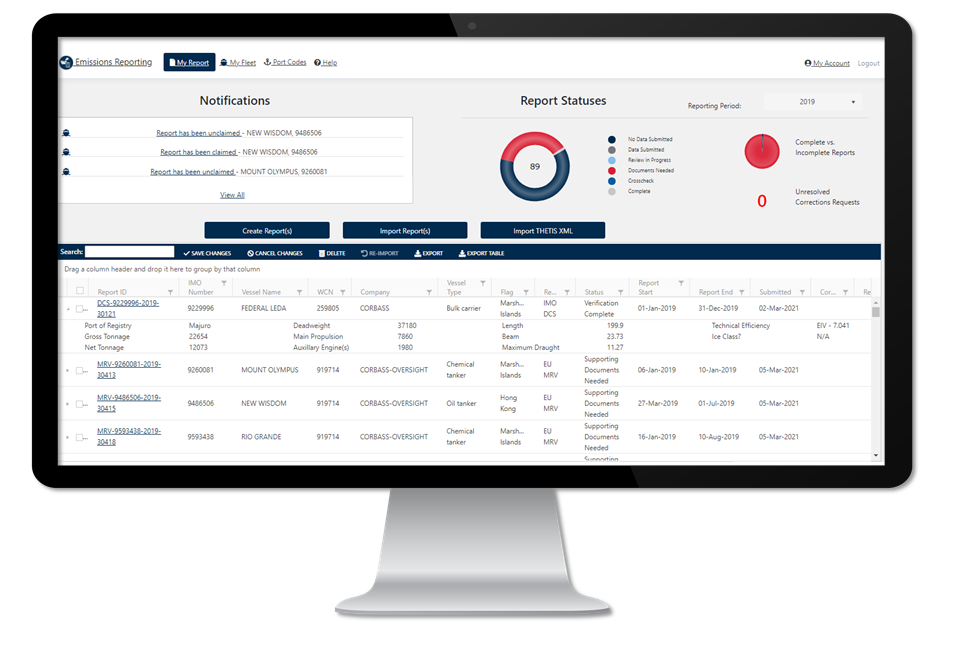
The ABS Emissions Reporter™ is a smart digital tool that allows owners and operators to input annual reports and monitor the status of their IMO Data Collection System (DCS)EU Monitoring Reporting and Verification (MRV) and UK MRV review process.

ABS Assistance

ABS is able to support by:

  • Assessing the monitoring plan. In doing so, we will verify that the appropriate monitoring plan template is used and that all information as required by the UK MRV Regulations is provided. We will confirm the information in the plan accurately describes the emissions sources and measurement equipment installed on the ship. In addition, we will communicate any recommendations for improvement which are identified. 
  • Verifying the emissions report is prepared in conformance with the accepted monitoring plan.

Please contact your local ABS office for scheduling assistance or send your request to MRVABSLondon@eagle.org.


Disclaimers

Impartiality

All work is to be undertaken in accordance with the ABS Code of Ethics.  The ABS Code of Ethics includes procedures for the identification, disclosure and remediation of all actual or potential conflicts of interest, and prohibits ABS personnel from carrying out activities on behalf of ABS that pose an unacceptable risk to their impartiality or in respect of which they have conflicts of interest.  


Complaints & Appeals

Any disagreement regarding the proper interpretation of the UK MRV requirements or complaints regarding the ABS service can be referred to ABS for resolution. ABS can be contacted via email at: MRVABSLondon@eagle.org.